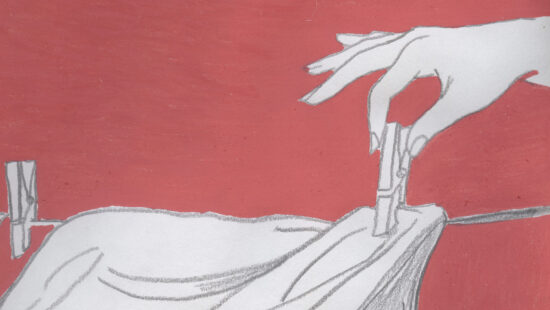
Halfway between the intimate world and the public space, hanging laundry and sheets on the line exert an inevitable pull on us. What is Sophia Loren thinking as she hangs out her washing in Una giornata particolare? Aren’t white sheets screens within screens? Why are ghosts depicted covered in sheets? Do all these scenes carry enough weight to become icons of cinema’s secret grammar? Erri De Luca tells us that when the first travelling projectors began to arrive in the villages, Italians christened this fascinating invention “the tangle in the sheet” (L’imbroglio nel lenzuolo). There could be no better definition.
Like many others, this project begins with a blank notebook in which we jotted down scenes from films featuring sheets that seemed to serve a particular function in the story. Later, we extended the list to the characters who hang out washing… Finally, we analysed the material at the Tabakalera Film and Audiovisual Laboratory, as part of a workshop run by Tabakalera and the Elías Querejeta Film School. This unclassifiable video essay is the result of the experiment.
A couple of notes: imbroglio means both “tangle/muddle” and “trick/swindle”, so “the tangle in the sheet” keeps the wordplay reasonably well, though “the muddle in the sheet” is an alternative. I used “Sophia Loren”, the usual spelling, since the original’s “Sofia” is a variant. Also, “Laboratorio de Cine y Audiovisual” could be left as is if you prefer to keep the institutional name in Spanish.
Harkaitz CanoClothes and sheets hanging out are one of those everyday scenes we are used to. But what is the function of those white shirts and sheets exposed to the air? What does Sophia Loren think as she lays out the mended rags in Una Giornata particolare? Are these scenes strong enough to become icons of the secret grammar of celluloid?