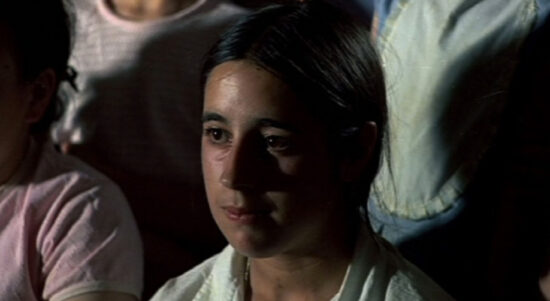
The year was 1968. I was 22 years old. I had shot the odd short film with Emilio M. Lázaro and Augusto M. Torres, when the NO-DO (the mandatory newsreel under Franco in all cinemas) contracted me for a piece commissioned by Minister Fraga Iribarne. It was to promote the Public Television station that had been recently opened for its ability to indoctrinate and numb the population through its programmes. As the TV sets were expensive, the idea was to put one in any premises – even schools or stables – of each town or village, so that people would go to those Tele-clubs to worship it with the same fervour as they prayed in church.
I made the documentary. It was screened in ZINEBI the following year. It won one of its top awards. I returned to Madrid, expecting to be congratulated by the top brass at NO-DO; but as soon as I was arrived, I was immediately sacked and banished.
From what I could gather – such things were not explained – Mr. Iribarne had been annoyed by the shots of his compatriots speaking Galician (which was banned), the meetings of cooperatives (banned) and, above all, the terrible extreme poverty in both Las Hurdes and in Galicia that I had portrayed.
There were five of us in the film crew, and despite our shortcomings, we formed a friendly and passionate tight-knit group. Even though I had the fewest technical skills, I did harbour certain filmmaking pretentions. Not for nothing I had been in Paris where I had seen Viridiana and À bout de souffle, where I got the bug to make films or to die in the attempt (it was the age of exaggeration).
To share an anecdote, when I asked the operator to take the camera off the tripod and to shoot with it on his shoulder, he asked me ‘how he was going to do that, as the picture would wobble and he could be fired’. I had to convince him – oh, the Nouvelle Vague! –, along with the sound technician to tie a hand microphone to a large stick to record location sound from the people that we were filming (it was brand new).
My intention when making the film was to use pure and direct images to document the reality that we were going to find among the locals who went to the tele-clubs. Nothing more. Nothing less. Without bias or stretching the meaning. And, in fact, I believe that – given the impact of its screening – that filmic reality prevailed over the propaganda sought by the Regime, and despite the stilted text that one of the No-Do editors added as a voiceover. It was not possible to manipulate anything: that is how it was, that is how it stayed, and here it is.
I do not believe that I have betrayed that respecting reality (imagined or not) as the driving force of all my filmography, during the 44 years in which I could develop my love of cinema (I suggest my book Memorias to better understand my career and the history of Spanish cinema during the 3 stages in which I worked: Franco’s dictatorship, the Transition and the new century. I tell it unabashedly).
I hope today’s audience can see, with this revival, that Fascist dictates – such as those stalking us today – first destroy freedom of expression and then all the others.
Alfonso UngriaThe documentary immerses us in the world of teleclubs, gathering spaces in rural Spain under Franco’s dictatorship, where television coexisted with cultural activities such as film screenings and theatre performances. Promoted by the Ministry of Information and Tourism, these centres provide a lens through which the film explores the influence of new communication media on the customs and working lives of rural communities, portraying a reality rarely seen on the screens of the time.